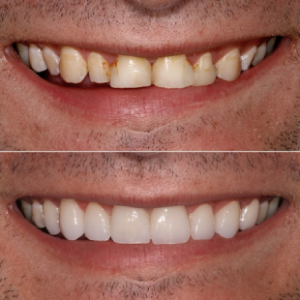
 From time to time, patients call our NYC cosmetic dentist Michael Kosdon, DDS, with a concern they’ve read about online or heard discussed elsewhere: something commonly referred to as “veneer breath.” While “veneer breath” is not a clinical term, it’s one that circulates often enough to cause understandable anxiety.
The good news is that veneers themselves are not known to cause bad breath. Porcelain is a nonporous material, and when properly designed and bonded to healthy enamel, veneers do not trap bacteria or create odor. When unpleasant breath develops after cosmetic dental treatment, there is almost always an underlying reason – and in most cases, it comes down to how the veneers were designed and fitted.
What People Mean by “Veneer Breath”
When someone says they have “veneer breath,” they’re typically describing persistent bad breath that began after receiving porcelain veneers. The natural assumption is that the veneers are somehow harboring bacteria beneath them or preventing proper cleaning. In reality, however, properly designed and precisely fitted veneers should not create this issue.
Unpleasant odor can develop when veneers are poorly contoured or improperly sealed at the margins where porcelain meets natural tooth structure. If small gaps exist (even microscopic ones), bacteria can collect at the edge of the restoration. If the veneers are too thick or extend in a way that disrupts the gumline, plaque may accumulate more easily. Over time, that buildup can contribute to inflammation, irritation, and odor.
In other words, “veneer breath” is not a veneer problem; it’s a fit and planning problem.
When veneers are crafted thoughtfully, with careful attention to margin placement and gum health, they should feel seamless and allow for normal brushing and flossing. They should integrate with the tooth and surrounding tissue in a way that supports long-term oral health.
Why Technique Matters
Porcelain veneers do more than simply sit on the front of teeth; they interact with enamel, gum tissue, bite alignment, and overall oral biology. If veneers are placed without sufficient attention to these details, complications can follow.
When patients report odor after a veneer treatment performed elsewhere, it’s often related to one or more of the following:
- Teeth that were over-prepared
- Veneers that are bulky or improperly contoured
- Margins that are difficult to clean
- Gum tissue that has become chronically irritated
Over-preparation is particularly significant. When excessive tooth structure is removed, the restoration may need to compensate in ways that affect how it meets the gumline. That transition area is critical. If it isn’t smooth and biologically respectful, plaque retention increases and the gums can become inflamed, which is one of the most common contributors to halitosis.
These issues are preventable when veneers are designed with precision and placed by a dentist like Dr. Kosdon, who prioritizes both appearance and long-term integrity.
Preventing “Veneer Breath” Starts With Planning
Preparation style is only one part of the veneer equation. The overall design, contour, and finishing of the veneers are just as important, as is how the gums respond after placement. Healthy tissue should appear firm and pink, not puffy or inflamed. If gum irritation persists, it may signal that the contours need to be evaluated.
Proper hygiene also plays a role. Even beautifully placed veneers require consistent brushing, flossing, and routine professional cleanings. Veneers do not eliminate the need for preventive care; they depend on it.
When these principles are followed, breath concerns are rarely part of the conversation.
A Bespoke Approach to Cosmetic Dentistry
Cosmetic dentistry should never feel formulaic.
Every smile exists within a unique facial structure, bite relationship, and biological environment. Veneers that work beautifully for one patient may be inappropriate for another. That’s why a bespoke approach matters – one that evaluates tooth position, arch form, enamel quality, gum health, and long-term stability before a single tooth is touched.
Some patients are excellent candidates for conservative preparation. Others may require a different strategy to achieve a balanced and biologically sound result. The difference lies in careful diagnosis rather than trend-driven treatment.
At our practice, “veneer breath” is not a frequent issue. That said, because it is widely discussed online, patients understandably ask Dr. Kosdon about it. The honest answer is that odor is not an inherent side effect of veneers. When it occurs, it is typically related to craftsmanship, contour, or tissue response – not porcelain itself.
If you’re considering veneers and have concerns about veneer breath, the most important step is choosing a dentist who values precision and comprehensive oral wellness as much as aesthetics. Reach out to our office today to schedule a consultation with Dr. Kosdon, our world-renowned cosmetic dentist.
Resources
Biology Insights
Multidisciplinary Digital Publishing Institute (MDPI)